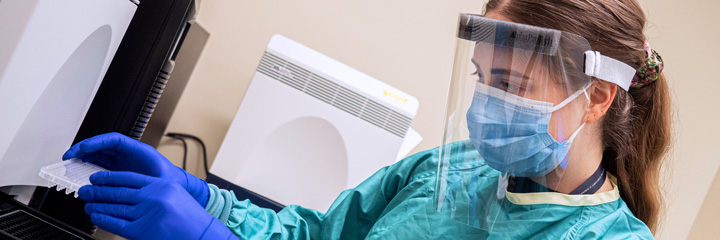
Flow Cytometry
The Flow Cytometry department performs a wide variety of testing which includes immunophenotyping of cells used for the diagnosis of leukemia/lymphoma, CD4 counts for persons living with HIV/AIDS, platelet antibodies and platelet reticulocytes.
Use a Flow Cytometry requisition to ensure the correct test is ordered, the correct sample is collected, and to avoid delays in transport and processing the samples. When in doubt, please call the laboratory at 403-944-4771
/ 403-510-9951(weekends) for assistance.
Some tests such as CD4 are restricted. Non-HIV related requests must be approved by Flow Cytometry (403-944-4771
).
Service Hours
Regular hours of operation (exclusive of statutory holidays):
- Monday: 07:00-16:15
- Tuesday to Friday: 07:00-23:15
- Sunday: 08:00-16:15
Completing the Test Request Form
See Completing the Requisition.
Specimen Labelling Criteria
See Specimen Identification (Labelling).
Collection Guidelines for Leukemia/Lymphoma Panels
1. Tissue/Lymph Node
- Obtain 2-3 mm thick cross section of fresh, unfixed lymph node. DO NOT disintegrate or mince the tissue to allow subsequent Giemsa-Wright touch stain preparations to be performed.
- Place in Tissue Transport Medium (TTM). If TTM is not available, use normal saline and deliver sample immediately to Flow Cytometry.
- If adding TTM to the sample, ensure that the media is completely thawed before adding to sample.
- Any samples submitted to Flow Cytometry MUST NOT be put into cytology fixative.
- Sent samples to the Flow Cytometry lab as soon as possible, however, they may be kept at 4°C overnight if testing is not started on the same day. Samples must not be frozen.
- Prior notification (403-944-4771
) that a sample is expected to arrive at the Flow lab is recommended.
- Ultimately, the decision on how much and if any tissue or body fluid should be sent for immunophenotypic analysis lies in the hands of the referring pathologist/cytologist supervising the processing of the specimen at the referring hospital site.
2. Peripheral Blood
- Collect in yellow top ACD "A" tube (8.5mL draw). Partial draws are not recommended as the anticoagulant is hypotonic, Peripheral blood samples in ACD "A" optimally should be tested within 24 hours. Some samples may be stable up to 5 days when stored at 4°C.
- ACD "B", EDTA, and heparin are also acceptable if ACD "A" is not available. EDTA samples must be tested within 24 hours and heparin samples must be tested within 48 hours when stored at 4°C.
- Hemolyzed, frozen, or clotted samples are not accepted.
- Whenever possible, the peripheral blood requiring flow cytometric analysis should be accompanied by a peripheral blood smear. This will provide morphologic correlation for accurate interpretation of the immunophenotypic data.
3. Bone Marrow
- 1 mL of bone marrow aspirate should be collected in 3mL of Bone Marrow Media (BMM) available from Flow Cytometry (403-944-4771
). The media may be kept frozen at –70°C until needed. When adding BMM to the sample, ensure that the media is completely thawed before adding to sample. BMM may be stored at 4°C for 1 week after thawing.
- Any samples submitted to Flow Cytometry MUST NOT be put into cytology fixative.
- Sent samples to the Flow Cytometry lab as soon as possible, however, they may be kept at 4°C overnight if testing is not started on the same day.
- Hemolyzed or frozen samples are not accepted. Clotted samples may be submitted for testing, however, it is a suboptimal specimen and results may be unreliable. In the event of a dry tap, a core biopsy may be submitted for testing.
- Whenever possible, a bone marrow smear(s) collected at the bedside, should accompany the aspirate for testing in the Flow Cytometry lab. This will provide morphologic correlation to aid in accurate interpretation of the immunophenotypic data.
4. CSF and Body Fluids
- Use Flow Cytometry requisitions to avoid delays in specimen transport. Include clinical diagnosis and indicate if performing immunophenotyping analysis (lymphoma, acute leukemia) and/or DNA cell cycle analysis/ ploidy (carcinoma, glioma).
- Quantity of specimen required is dependent on cellularity.
- A minimum of 2 mL of CSF is required. 10 mL of CSF is preferred to ensure adequate cells for testing.
- A minimum of 10 – 20 mL of body fluid is required. Any samples submitted to Flow Cytometry MUST NOT be put into cytology fixative. If adding TTM to the sample, ensure that the media is completely thawed before adding to sample.
- Samples should be sent as soon as possible to the Flow Cytometry lab. Prior notification at 403-944-4771
that a CSF or body fluid specimen is expected to arrive at the flow lab is recommended.
- Cells from the CSF or fluid may be stored overnight at 4°C in TTM.
- See CSF Collection Guidelines
5. Fine Needle Aspirates (FNA)/ Core Biopsies
- Unfixed fine needle aspirate/core biopsies should be submitted to the Department of Histopathology at Foothills Medical Centre together with the specimens destined for histopathologic processing. A pathologist on duty will be responsible for referring a portion of the obtained tissue for immunophenotypic analysis, where appropriate.
- FNA’s and core biopsies should be put in TTM and delivered ASAP
6. Urine/Bladder Wash/Cath Urine
- Urines for DNA analysis (ploidy/cell cycle analysis) should be received within 4 hours of collection.
Tissue Transport Medium (TTM) Information
- TTM may be obtained from Cytology at 403-944-4758
- TTM may be stored at 4°C for 1 week after thawing
- The media should have an orange-pink appearance
- A colour change to dark pink or yellow indicates a pH change, and the media should be discarded
- Can be frozen for 1 year at -20°C or indefinitely at -70°C